Business & studio
Integrating iris photography into your studio workflow
Iris photography can be added to an existing studio either as a standalone service or alongside portrait, family and event work. With a practised routine, the capture itself takes only a few minutes. IRISORA then automates the time-consuming preparation of the iris, turning it into a predictable and scalable studio workflow.
Short answer
The capture itself takes roughly 3 to 5 minutes per person. An appointment with four or five people can take about 30 to 40 minutes including consultation and organisation. Automated processing with IRISORA removes a large part of the manual retouching that used to follow.
An additional workflow, not a second studio
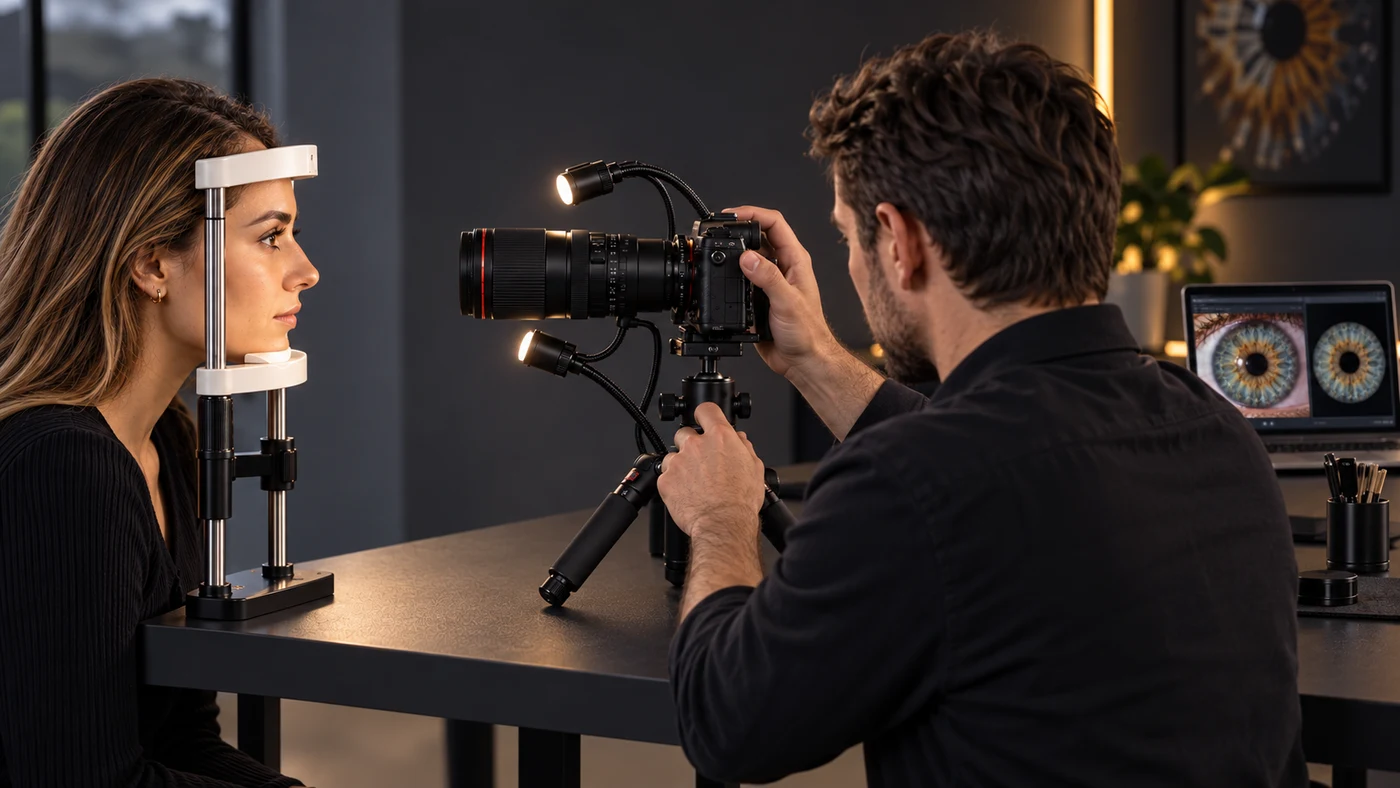
Iris photography needs only a small, consistent capture station. It can stay permanently set up or be assembled on dedicated iris photography days.
- Short appointments that are easy to schedule and always follow the same routine
- Individuals, couples and families all work with the same station
- Consultation happens largely once per appointment, not again for every person
- Multi-person appointments are therefore particularly efficient
- Processing does not have to happen while the client is in the studio
- After upload, IRISORA handles the recurring technical steps
- Capture the iris
- Select the best image
- Upload to IRISORA
- Automated processing
- Review the result
- Download the 4K iris or create artwork
- Deliver digitally or sell a print product
While IRISORA processes the images, the next appointment can already take place.
The capture itself takes only a few minutes
Consultation, product selection and organisation largely occur once per appointment. That is why a session with four or five people does not take four or five times as long as a single session. Only the actual capture time grows with each additional person.
Experience values per appointment type
- Actual capture time per person3–5 min
- Single appointment incl. consultation15–25 min
- Couple appointment20–30 min
- Appointment with four to five people30–40 min
Once per appointment
- Welcome
- Consultation
- Product selection
- Closing and organisation
Per person
- Positioning
- Capturing both eyes
- Sharpness check
10–12 appointments per day
With efficient scheduling, a permanent capture station and a fully booked calendar, around 10 to 12 appointments per photographer and working day may be possible.
30–35 people on a busy Saturday
Approximately 30–35 people on a fully booked shooting day – based on Florian Böhm’s practical experience.
These are experience values, not guaranteed capacity. Actual timing depends on consultation, group size, shooting conditions and your personal working method.
More appointments instead of hours of manual retouching
Capture is only one part of the workflow. In traditional manual editing, iris, pupil, outer edge, reflections, colours and structures are prepared individually for every single image. These recurring technical steps are what limits the number of jobs many studios can take on.
IRISORA automates a large part of this recurring preparation. The photographer remains responsible for capture, image selection and the final quality review.
- Automated preparation of the iris
- Isolation and preparation
- 4K output (4096 × 4096 pixels)
- Review and individual adjustment
- Download of the isolated iris
- Optional design in the Art Style Editor
- Use of your own effects and design elements
- Saved presets for recurring designs
- Structured projects per appointment
- No monthly base fee
- Billing based on the credits you use
Traditional manual editing
- Select the image
- Isolate the iris
- Edit the pupil
- Edit the outer edge
- Check reflections
- Correct colours and structures
- Export
- Create the artwork
In manual editing, every one of these steps is repeated for each individual iris.
Workflow with IRISORA
- Select the image
- Upload
- Automated processing
- Review the result
- Download or design
Capture, selection and final approval stay with the photographer. IRISORA handles the recurring technical steps in between.
What does a photo studio need for iris photography?
| Equipment | Purpose | Approximate entry level | Often already owned |
|---|---|---|---|
| Camera | Capturing the iris | depends on your existing system | yes |
| Macro lens | detailed close-up | depends on your camera system | often |
| Chin and forehead rest | stable head position | from approx. €60 | usually not |
| Macro LED light or macro flash | controlled lighting | from approx. €30–50 | sometimes |
| Small table tripod | consistent camera position | from approx. €40 | sometimes |
| Computer and internet | upload and review | normally in place | yes |
| IRISORA | processing and finalisation | billed via credits | no |
Camera
A mirrorless camera or DSLR with good image quality is generally suitable. Sharpness, accurate focus and consistent shooting conditions matter more than sensor resolution alone.
Macro lens
A true macro lens with a magnification close to 1:1 is recommended. Focal lengths of roughly 90 to 105 mm keep a comfortable working distance from the eye. Many portrait and product photographers already own a suitable lens.
Chin and forehead rest
A height-adjustable optometry chin rest with forehead support stabilises head and eye position. Simple models are available online from roughly 60 euros. The rest should be stable, adjustable and easy to clean.
Table tripod
A small, stable table tripod keeps the camera at a consistent height and working distance. Suitable options start at around 40 euros.
Macro lighting
Flexible macro LED arms or a suitable macro flash both work. Simple lighting solutions start at roughly 30 to 50 euros. A ring flash placed head-on can produce prominent reflections directly on the iris; laterally adjustable light sources give more control over the position and size of those reflections.
If camera and macro lens are already in place, the additional hardware starts at roughly 130 euros.
All prices are non-binding guide values. Quality, stability, scope of delivery and shipping costs vary between suppliers.
What an iris photography day can look like
The following schedule is an example, not a binding plan. It shows how capture, upload and later design work can be distributed across a studio day.
Example day schedule
- 09:00Single appointment
- 09:30Couple appointment
- 10:15Family appointment
- 11:00Single appointment
- 11:30Uploads to IRISORA
- 13:00Further appointments in the afternoon
- 17:00Review and design
IRISORA processes the uploaded images in parallel in the background.
Capture, automated processing and design do not have to happen back to back. That lets photographers use their appointment slots efficiently.
What can iris photography generate in my studio?
Model, without obligation, what revenue and what margin after IRISORA costs iris photography could generate in your studio. The calculation covers iris photography with digital files only. Optional print products are not included.
Your assumptions
Use the net price for iris photography including the digital files you deliver.
€2.00 per credit
All calculations run locally in your browser. No inputs are stored and no data is transmitted.
Results
- People
- 80
- Credits required
- 160
- Net revenue
- €3,920.00
- IRISORA cost
- €320.00
- IRISORA cost per person
- €4.00
- Contribution margin per person
- €45.00
- Potential contribution margin
- €3,600.00
- Margin after IRISORA costs
- 91.8 %
With 20 people on 4 days per month and a net price of €49.00 per person, the model shows a theoretical net revenue of €3,920.00 per month. After the pro-rata IRISORA costs, a potential contribution margin of €3,600.00 remains. That is a margin after IRISORA costs of 91.8 %.
Revenue split
- IRISORA cost: €320.00 · 8.2 %
- Potential contribution margin before other operating costs: €3,600.00 · 91.8 %
Overview · Month
- Net revenue€3,920.00
- IRISORA cost€320.00
- Potential contribution margin€3,600.00
This is a non-binding model calculation. It excludes working time, studio rent, taxes, insurance, marketing, payment fees, cancellations and other operating costs. The figure shown is therefore not a guaranteed profit.
IRISORA costs are modelled pro rata from the credits consumed. Credits are actually purchased in packages, so payment timing and package size can differ from this monthly pro-rata view.
More people, but not proportionally more time
- Welcome and consultation happen only once per appointment.
- Product selection and design are often discussed together.
- Only the actual capture time grows with each additional person.
- Family and group appointments therefore raise revenue per booked slot.
- Several irises can be combined into a single artwork.
- Couple and family artworks open up additional potential for premium print products.
Appointment time by group size (experience values)
- 1 person≈ 20 min
- 2 people≈ 25 min
- 4 people≈ 35 min
- 5 people≈ 40 min
- Fixed appointment time
- Capture time per person
These are experience values as well. No revenue guarantee can be derived from them.
Additional revenue from print products
The calculator only includes iris photography with digital files. Optional print products can further increase revenue and contribution margin.
Acrylic glass
Glossy wall presentation with strong depth.
Aluminium composite
Robust direct print, matte or glossy, frameless.
Canvas
Restrained surface for larger wall formats.
Fine art print
Textured paper for detailed iris structures.
Framed print
Classic presentation with passe-partout and frame.
Couple or family artwork
Several irises combined into one composition.
Optional print products can noticeably increase revenue and contribution margin.
Capture quality and studio practice
Processing can only be as good as the capture. These points decide the outcome in day-to-day studio work.
- Capture the iris as large and as sharp as possible
- Focus precisely on the iris structure
- Include the pupil and the full outer iris edge
- Keep reflections small and controllable
- Reduce coverage by eyelashes and eyelids
- Take several frames per eye
- Check sharpness on a larger screen before the client leaves
- Ask clients to remove contact lenses before the capture
- Clean the chin and forehead rest after every appointment
- Never make medical statements or diagnoses based on the iris
Related in-depth articles
Frequently asked questions
- What do I need to offer iris photography in my studio?
- A camera, a macro lens, a chin and forehead rest, a small table tripod, controllable macro lighting, a computer with an internet connection and IRISORA for processing and finalising the iris.
- How much does the additional equipment cost?
- If camera and macro lens are already in place, the additional hardware can start at roughly 130 euros. This is a non-binding guide value only.
- How long does capturing an iris take?
- With a practised routine, the capture itself takes approximately 3 to 5 minutes per person.
- How long does an appointment with several people take?
- An appointment with four or five people can take roughly 30 to 40 minutes including consultation, capture and organisation.
- How many appointments fit into one day?
- With efficient scheduling and a permanent capture station, around 10 to 12 appointments per photographer and working day may be possible. The real figure depends on your consultation style, group sizes and working method.
- Do I need a dedicated iris camera?
- No. A suitable mirrorless camera or DSLR with a good macro lens can be enough. Sharpness, magnification, stabilisation and light control matter more than a specialised body.
- Why does the chin and forehead rest matter?
- It stabilises head and eye position, which makes working distance, focus and framing reproducible from person to person.
- Can I use a ring flash?
- In principle yes. Frontal ring reflections can cover larger parts of the iris, so laterally positioned macro lights or angled flashes usually give more control.
- Do I need Photoshop?
- Photoshop remains useful for additional external design work. It is not required for automated processing, isolation, 4K output or design in the Art Style Editor.
- How does IRISORA reduce the workload?
- IRISORA automates the recurring technical steps of iris preparation. The photographer still handles capture, image selection and the final quality review.
- Can I test IRISORA before my first client appointment?
- Yes. New studios receive 5 free processing credits and pay no monthly base fee.
- Is the calculated contribution margin a guaranteed profit?
- No. The calculator only accounts for the revenue and IRISORA costs you enter, plus optional equipment. Other operating costs and your working time are not included.
Test iris photography in your own studio
An existing photo studio usually has most of the requirements already. With a small capture station, a few additional components and IRISORA's automated processing, iris photography fits efficiently into day-to-day studio work.